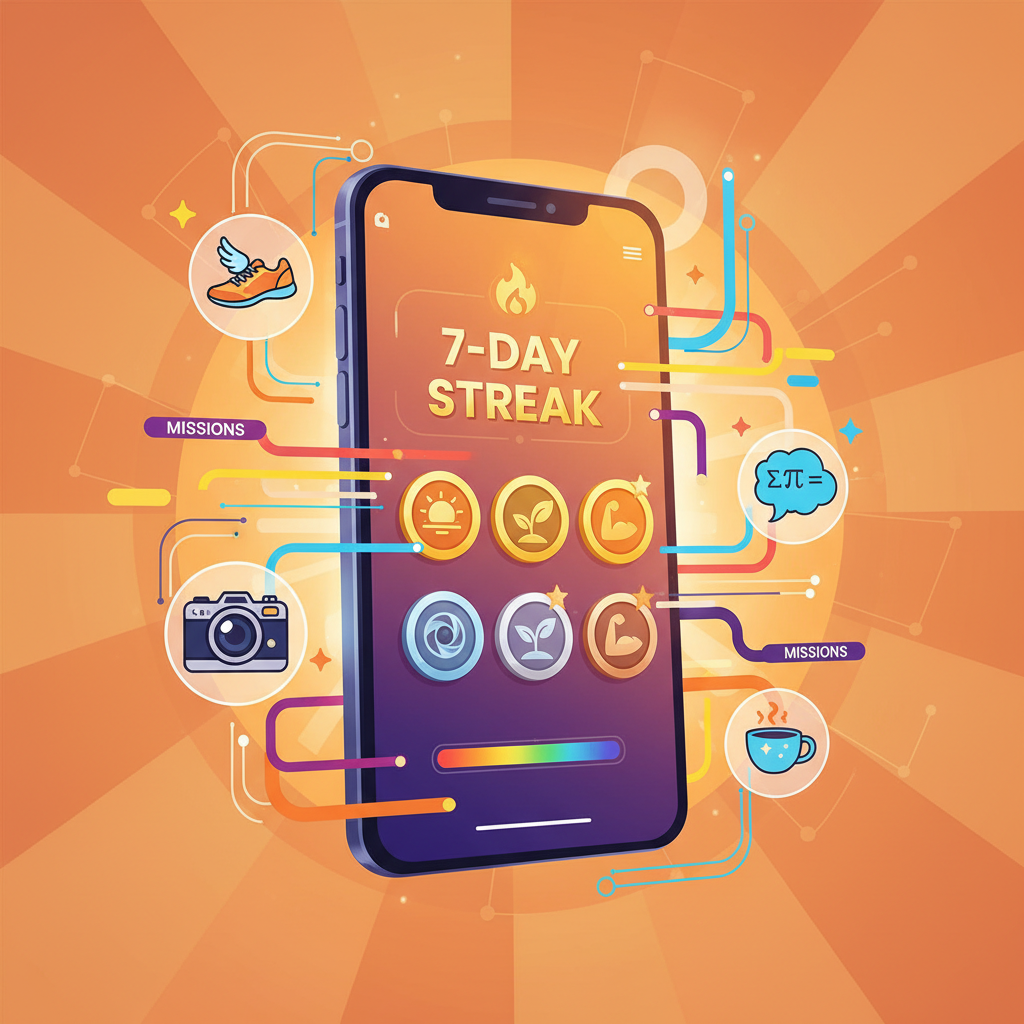
Why Gamified Alarm Apps Actually Work: The Psychology Behind Wake-Up Missions
You wouldn’t use a to-do app that just lists tasks with no checkboxes. You wouldn’t play a game with no score. So why do most alarm apps still just… beep?
The rise of mission-based alarm apps isn’t a gimmick. It’s backed by decades of behavioral psychology research. Here’s why gamification turns your alarm from something you hate into something that actually works.
The Problem With Normal Alarms
A standard alarm app does one thing: make noise until you tap “dismiss.” The problem? Your half-asleep brain can dismiss an alarm without ever truly waking up.
Sleep researchers call this automatic behavior during sleep inertia — your motor skills can perform simple, practiced actions (like swiping a screen) while your prefrontal cortex is still offline. You’re essentially sleepwalking through your alarm.
This is why people “don’t remember” hitting snooze. They genuinely weren’t conscious enough to form a memory.
How Missions Break the Autopilot
Mission-based alarms work because they require novel cognitive or physical engagement — things your autopilot brain can’t do.
Physical Missions
Tasks like walking 50 steps, doing squats, or shaking your phone raise your heart rate and blood pressure. This triggers your sympathetic nervous system (the “fight or flight” response), which is the fastest way to transition from sleep to wakefulness.
Research shows that just 20 seconds of physical activity upon waking can reduce sleep inertia by up to 50%.
Cognitive Missions
Solving math problems, typing phrases, or memory challenges activate your prefrontal cortex — the executive function center of your brain. This is the part responsible for decision-making, planning, and self-control. Once it’s online, your brain shifts from “sleep mode” to “awake mode.”
Verification Missions
Photo-based missions (taking a picture of the sky, scanning your made bed, photographing a specific object) combine physical movement with visual processing. You have to get up, move to a location, assess what you’re seeing, and take an action. By the time you’re done, you’ve engaged nearly every wakefulness pathway in your brain.
The Psychology of Streaks
Streaks are the secret weapon of gamified alarms. Here’s why they’re so psychologically powerful:
Loss Aversion
Humans feel the pain of losing something roughly twice as strongly as the pleasure of gaining something equivalent. This is called loss aversion, and it’s one of the most robust findings in behavioral economics.
When you have a 21-day streak, your brain doesn’t think “should I get up?” It thinks “can I really throw away 21 days?” That reframe changes everything.
The Sunk Cost Effect
Every morning you complete adds to your “investment.” The longer your streak, the more it feels like you’ve built something valuable. Walking away becomes progressively harder.
Social Identity
After maintaining a streak for weeks, it becomes part of how you see yourself. You’re no longer “trying to wake up early” — you’re someone who has a 30-day streak. This identity shift is more powerful than any motivation trick.
Badges and Variable Rewards
Badges and unlockable themes tap into what psychologist B.F. Skinner called variable ratio reinforcement — the most addictive reward schedule known to psychology (it’s the same mechanism behind slot machines and social media likes).
When you don’t know exactly when the next reward is coming (a new badge at day 3, then day 7, then day 14…), your brain stays engaged. Each morning becomes a potential reward event, which creates anticipation rather than dread.
In Wak, the theme system works this way: you unlock Risen at day 1, Ignite at day 3, Horizon at day 7, Aurora at day 14, Celestial at day 30, and Nebula at day 100. Each unlock feels like a genuine achievement because you earned it through consistent action.
The Micro-Win Effect
Completing a wake-up mission is a small victory, but it has outsized psychological effects. Research on self-efficacy (your belief in your ability to succeed) shows that early wins create a positive feedback loop:
- You complete the mission → small dopamine hit
- Dopamine improves your mood → morning feels better
- Better morning → more likely to complete tomorrow’s mission
- Streak grows → motivation increases
- Repeat
This is why the first few days are the hardest but the momentum builds quickly. Each morning reinforces the behavior.
Why Difficulty Levels Matter
Not everyone needs the same level of challenge. This is a key insight from flow state psychology: tasks that are too easy become boring, and tasks that are too hard become frustrating. The sweet spot is a challenge that matches your current ability.
For alarm missions, this means:
- Easy missions (Face ID, Shake Phone) are perfect for building the initial habit
- Medium missions (Solve Math, Object Hunt) add cognitive challenge once the habit is established
- Hard missions (Push-Ups, Walk 50 Steps, Gym) create a powerful physical activation that makes falling back asleep nearly impossible
The best approach is to start easy and gradually increase difficulty as your morning consistency improves.
The Data Speaks
A 2021 study in Sleep Science and Practice found that participants using gamified sleep-wake interventions showed:
- Faster transition to full alertness compared to standard alarms
- More consistent wake times over a 30-day period
- Higher subjective morning energy ratings
- Better adherence to target wake times
The gamification didn’t just make waking up less painful — it made people want to maintain their wake-up habits.
The Bottom Line
Gamified alarm apps work because they align your alarm with how your brain actually works. They turn dismissal into engagement, dread into achievement, and isolation into a streak you don’t want to break.
The question isn’t whether gamification works for waking up. The research is clear on that. The question is whether you’ll start tonight.

Ready to stop hitting snooze?
Try Wak free and join 500,000+ people who transformed their mornings.
Try Wak Free